



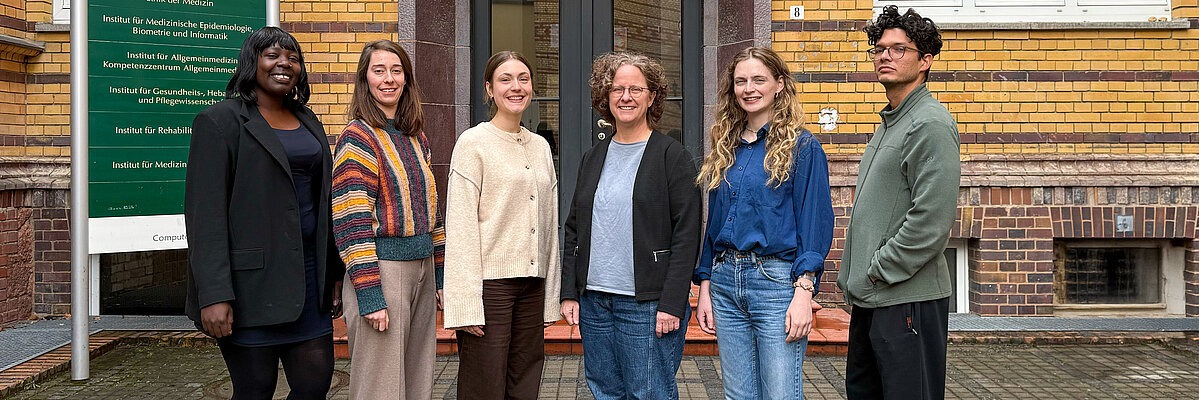
Group Lead
Prof. Dr. Eva Kantelhardt
Post-Docs
Dr. Lena Fiebig
Dr. Nikolaus Mezger
PhD Students
I am an environmental epidemiologist and geographer specializing in the intersection of urban planning and public health, with special interest in the Global South. By integrating spatial data analysis with biostatistical methods, I address complex environmental challenges through a lens that balances rigorous analytical discipline with creative, multi-dimensional problem-solving.
Hi, I am an environmental health scientist and my work sits at the interface of climate change, population health, and community resilience.
My doctoral research investigates climate-related health risks in Kenya, focusing on how community-perceived knowledge, attitudes, and practices interact with environmental change, governance, and health system preparedness to shape vulnerability and adaptive capacity. I also explore perspectives on climate adaptation, health risks, and strategies to strengthen community resilience across the country.
My research interests are diverse and interdisciplinary, spanning climate change and health, heat exposure and health in refugee settings, child health and nutrition, gender and health equity, aquaculture and food security, environmental geochemistry and health, antimicrobial resistance, digital health, and applied epidemiology. I am particularly interested in translating scientific evidence into strategies that improve early-warning systems, community adaptation, and equitable health outcomes for vulnerable populations.
Alongside my doctoral work, I collaborate with international partners, including KLUG – German Alliance on Climate Change and Health. I am also the founder of the Planetary Health Eastern Africa Hub of the Planetary Health Alliance, focused on advancing regional cooperation, capacity building, and youth leadership in climate and health.
My academic career bridges European and African research environments and is dedicated to producing actionable knowledge that contributes to equitable, climate-resilient, and sustainable futures.
Hi, I am Rachel, a first-year PhD candidate with a background in biochemistry. My main research interest lies in understanding the diverse impacts of human-driven environmental change on health, with a particular focus on how environmental heat exposure affects pregnant women and their babies. I am committed to a gender-transformative Planetary Health approach- one that not only addresses the health risks posed by extreme heat, but also confronts the structural gender inequalities that shape vulnerability. In the “HeMAB” study I investigate the association of environmental heat with the physiology of pregnant women and fetal strain. For this, I am using wearable and environmental sensors that continuously capture physiological and exposure data, enabling a more comprehensive and integrated understanding of maternal responses to heat stress. I am also a “Planetary Health Campus Ambassador” for the year 2026. ( (Planetary Health Campus Ambassadors - Planetary Health Alliance)
Hallo, ich bin Rachel und in meiner Forschung beschäftige ich mich mit den gesundheitlichen Folgen des Klimawandels. Besonders interessiert mich, wie sich Hitze auf schwangere Frauen und ihre ungeborenen Kinder auswirkt. Ich arbeite an der “HeMAB” Studie. Hier untersuchen wir nicht nur die direkten gesundheitlichen Risiken extremer Hitze, sondern berücksichtigen auch die strukturellen Ungleichheiten, die dazu führen, dass Frauen* stärker durch den Klimawandel gefährdet sind. Spezifisch erforsche ich die Assoziation von Hitze mit der Physiologie schwangerer Frauen. Dafür setze ich tragbare Sensoren, sogenannte “Wearables” sowie Umweltsensoren ein, die kontinuierlich physiologische Daten und die individuelle Hitzeexposition erfassen. So versuchen wir besser zu verstehen, wie der Körper auf Hitzestress reagiert und welche Auswirkungen dies auf Mutter und Kind hat. Ich bin außerdem “Planetary Health Campus Ambassador” 2026. (Planetary Health Campus Ambassadors - Planetary Health Alliance)
I am a global health expert, advocate and researcher with over ten years of experience working in Yaounde, Cameroon. Passionate about epidemiology and global surveillance systems that improve understanding of health outcomes. I am currently Principal Investigator for Yaounde, Cameroon with the Global Asthma Network(GAN), completed the first global study with the University of Yaounde I on the prevalence and severity of self reported asthma in relation to environmental risk factors. My current research involves building multidisciplinary and global teams for climate health attribution data digitalization tools and capacity. Investigating the impact of heat on emergency hospital outcomes in Cameroon, Kenya and South Africa with a focus on cardiovascular, respiratory and mental health disorders. I am keen to bring insights on the intersection between heat and air pollution in driving the climate crisis, as well as mainstreaming key findings into educational curricula for teachers and students.
I am Lena and started working as a PhD student in the Working Group “Global and Planetary Health” in December 2025. I have a background in health communication, and my research focuses on the health impacts of climate change, particularly in low- and middle-income countries. I am currently conducting a KAP study (Knowledge, Attitudes, and Practices) in Ethiopia, investigating how communities perceive climate-related health risks, such as heat exposure, air pollution, and vector-borne diseases, and which adaptation strategies are considered feasible and effective. The aim is to generate evidence that supports climate-resilient health systems and informs targeted public health interventions. Beyond adaptation and health systems research, I am also interested in the mental health dimensions of climate change. In my master’s thesis, I examined psychological responses to climate change, with a particular focus on climate-related anxiety and associated sociodemographic and personality factors. In the future, I would also like to further explore the social dimensions of climate change, including issues such as climate-related migration, social vulnerability, and health inequities. Overall, my work seeks to better understand both the structural and individual health consequences of climate change and to contribute to evidence-based strategies that protect and strengthen population health in a rapidly changing world.
Hi, I’m Mary and have been a PhD student since December 2025 and a member of the Planetary Health Working Group since January 2026. I completed my Bachelor's degree in Paramedic Science in 2019 and worked as a paramedic in London, UK, for the next six years. Inspired to learn more about health inequality and the structural factors that shape health outcomes worldwide, I completed a Master's in Global Health at Manchester University, UK, and graduated in September 2024. My Master’s thesis, titled 'Neo-colonialism and storm resilience: The UK's control over the Caribbean', examined how the UK continues to exert control over Caribbean nations by exploiting the population before, during and after the impact of storms, ultimately influencing the health of Caribbean populations. My current project focuses on the pre-hospital medical response to the initial impacts of a disaster, including environmental emergencies such as floods and storms. The project incorporates a comparative European perspective and aims to strengthen climate emergency response systems and resilience practices.