




The DINKNESH App

A Digital Platform Supporting the Cancer Care Continuum in Ethiopia
Core Modules:
- App-based Patient Documentation and Navigation for Breast and Cervical Cancer
- Digital Support for Community-based Palliative Care
Fragmentation across the cancer care continuum remains a major barrier to effective prevention, early detection, and timely treatment in many low- and middle-income countries. In Ethiopia, women with breast abnormalities or those treated for cervical precancerous lesions frequently experience delayed referral, insufficient follow-up, and loss to care due to weak referral systems, limited communication between facilities, and constrained resources at primary healthcare level.
To address these challenges, the Digital Global Health Working Group has developed the DINKNESH App—a context-adapted digital platform designed to support coordinated, patient-centered care across the cancer care continuum. The app is embedded within routine primary and secondary healthcare services and developed in close collaboration with Ethiopian health authorities, healthcare workers, and local technical partners.
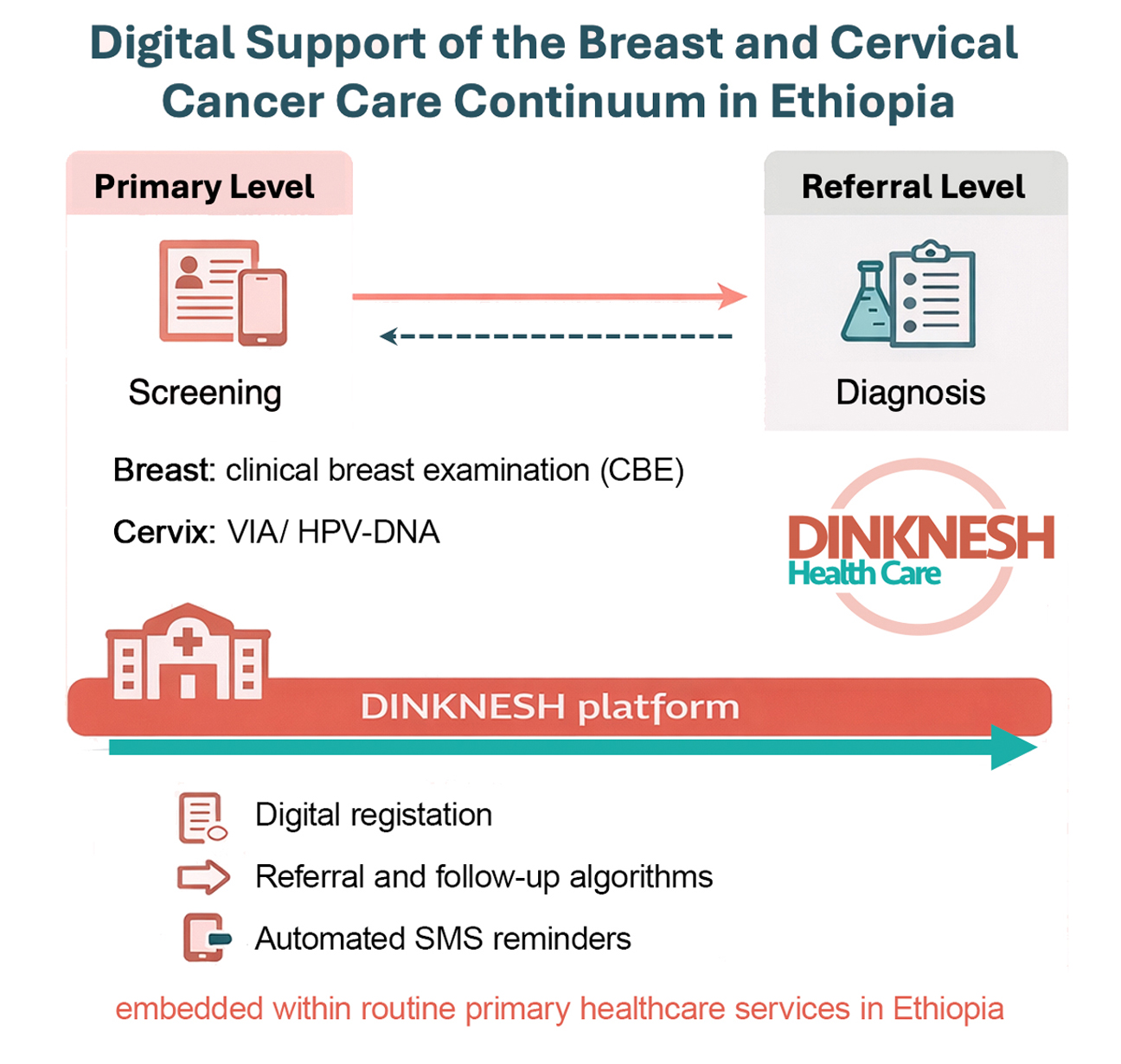
Clinical Documentation and Patient Navigation for Breast and Cervical Cancer
App based patient navigation for Breast and Cervical cancer from Screening to Diagnosis.
Next to the documentation of clinical findings to assure high quality medical information flow, patient navigation is a central function of the DINKNESH App. We focus on strengthening continuity of care from screening to diagnosis and follow-up for breast and cervical cancer.
The Android-based application, supported by a secure server backend, enables:
- digital patient registration at primary healthcare level,
- documentation of clinical and anamnestic findings
- structured referral pathways to higher-level diagnostic services,
- bidirectional communication between referring and receiving facilities,
- automated SMS reminders supporting appointments and follow-up for patients and health workers.
The platform was developed through an iterative, stakeholder-driven process and is currently embedded in pragmatic implementation studies conducted under routine service conditions.
- For breast cancer, a cluster-randomised study evaluates digitally supported referral pathways for women with abnormalities identified through clinical breast examination at primary healthcare facilities.
- For cervical cancer, a pragmatic cluster-randomised study assesses digital and community-supported follow-up strategies for women treated for precancerous cervical lesions in primary care.
Evaluation focuses not only on referral completion and follow-up adherence, but also on feasibility, fidelity, equity of reach, and health system integration. Capacity strengthening is embedded through local leadership, doctoral training, and long-term institutional partnerships.
Selected Publications:
Getachew E, Gizaw M, Anberber E, Shita A, Destaw A, Rossner SS, Tesfaw A, Addissie A, Kantelhardt EJ, Kroeber ES, Getachew S. (2026). E-health supported referral for patients with breast abnormalities at primary healthcare facilities in Ethiopia: protocol for a cluster-randomised controlled trial. Trials. PubMed: https://pubmed.ncbi.nlm.nih.gov/41519765/
Destaw A, Getachew S, Getachew E., Shita A., Midaksa, M., Rossner S., Kroeber E, Addissie A, Kantelhardt E, and Gizaw M.: (2025). Study protocol for key interventions to improve the follow-up adherence postcervical precancerous lesion treatment in Ethiopia: a pragmatic randomised controlled trial. BMJ Open. PubMed: https://pubmed.ncbi.nlm.nih.gov/39773801/
Destaw A, Getachew S, Getachew E, Shita A, Midaksa M, Rossner SS, Kroeber ES, Addissie A, Kantelhardt EJ, Gizaw M. (2025). Follow-up rescreening uptake and persistent positive rates among women after positive cervical cancer screening results in Ethiopia: a longitudinal cross-sectional study. BMJ Open. PubMed: https://pubmed.ncbi.nlm.nih.gov/40730399/

Digital Support for Community-Based Palliative Care
Palliative care is a core component of comprehensive cancer care and an essential service recognised within national health priorities. Within DINKNESH, we develop and evaluate digital support for community-based palliative care, with a focus on improving access, coordination, and quality of care at household and primary healthcare level.
The palliative care module of the DINKNESH App is designed to support Community Health Workers (CHWs) by:
- enabling structured assessment and monitoring of palliative care needs,
- providing decision support through clinical protocols and red-flag guidance,
- supporting information sharing and coordination across levels of care,
- offering embedded reference content on palliative care approaches.
This component was developed using a person-centered co-design approach involving health workers, facility managers, patients and families, policymakers, and digital health experts. It has undergone usability testing and implementation learning, with a focus on feasibility, ethical delivery of care, and integration into existing clinical workflows and health information systems.
While the palliative care module is currently implemented as part of research and development activities, it addresses priority services within the Ethiopian health system and informs future scale-up and implementation strategies.
This work is conducted in collaboration with King’s College London.
Manuscripts currently being prepared for publication:
(1) mHealth in home-based palliative care: a realist review of contextual factors and mechanisms of action that influence outcomes
(2) the potential for mHealth to improve access to palliative care in rural Ethiopian communities: a qualitative study
(3) improving access to community-based palliative care: a co-design and usability testing of a mobile application and systems support in Ethiopia
A Modular Platform with a System Perspective
The DINKNESH App is conceived as one integrated, modular platform supporting the cancer care continuum—from early detection and referral to follow-up and palliative care. Individual modules are implemented according to service priorities and maturity, while remaining embedded within a shared technical and health system architecture.
By combining digital tools with human support and implementation research, the DINKNESH App provides a scalable and adaptable foundation for strengthening cancer care and other chronic care pathways in resource-constrained settings.
Partners
- Ministry of Health,
- Addis Ababa University
- IWKET PLC (Ethiopian IT company)